
How to Start a Home-Based Catering Business in South Africa
A practical guide to startup costs, food-safety considerations, equipment, menu planning, pricing, customer acquisition and building a small catering business from home.

Editor’s note: This free guide helps South Africans investigate the practical realities of starting a catering business from home. It is educational information and does not replace advice from your municipality, environmental health practitioner, accountant, insurer or legal adviser.
Why a Home-Based Catering Business Can Work
Food is required for birthdays, funerals, church gatherings, school events, community meetings, office lunches, family celebrations, conferences and private functions. This creates opportunities for dependable caterers who can prepare good food, deliver it on time and manage orders professionally.
Starting from home can reduce the cost of renting a restaurant, commercial kitchen or shopfront. A beginner may be able to start with existing equipment, a limited menu, pre-orders and a small group of customers. The lower overhead does not mean the business is effortless, however. Catering requires careful food costing, hygiene, time management, customer communication and consistent quality.
Start Small
Begin with a few dishes that you can prepare consistently instead of offering an oversized menu.
Use Pre-Orders
Confirm quantities and deposits before buying ingredients or preparing food.
Know Your Costs
Include ingredients, packaging, electricity, labour, delivery, wastage and profit.
Build Trust
Good photographs, clear communication and reliable delivery can help generate referrals.
Types of Home-Based Catering Businesses
Your niche affects your equipment, menu, production schedule, marketing and startup budget.
| Business type | Typical customers | Possible starting approach |
|---|---|---|
| Family meals | Busy households, older customers and working parents | Weekly menu with pre-ordered portions |
| Lunch packs | Offices, workshops, construction teams and meetings | One or two set meals delivered at a fixed time |
| Platters | Businesses, birthdays, meetings and small functions | Standard platter sizes and advance orders |
| Church and community catering | Church groups, clubs and community organisations | Simple menus for larger groups |
| Funeral catering | Families, churches and funeral organisers | Clearly priced meal packages per person |
| Meal preparation | Professionals, students, families and fitness customers | Weekly packages sold in advance |
| Special-occasion catering | Birthdays, anniversaries, weddings and celebrations | Custom quotation with deposit and written scope |
| Traditional or specialised food | Customers seeking cultural, dietary or niche menus | Focused menu built around a specific strength |
Practical starting point: Choose one main customer, one core offer and a limited delivery area. It is easier to improve a focused offer than to manage ten unrelated catering services.
Can You Legally Run a Catering Business from Home in South Africa?
Do not assume that working from home removes the need to investigate food-safety, property or municipal requirements.
Requirements can differ according to your municipality, property, products, production methods and the scale of your operation. Contact the relevant municipal department or environmental health office and explain exactly what food you intend to prepare, where it will be prepared and how it will be stored and delivered.
Questions to investigate
- May commercial food be prepared from your property?
- Do zoning or home-business restrictions apply?
- Does your landlord, body corporate or homeowners’ association restrict business activity?
- Does the food-preparation area need inspection or approval?
- Are certificates, permits or registrations required?
- What food-storage and temperature-control standards apply?
- What records should be maintained?
- Are additional rules triggered by employing staff or selling alcohol?
Food-safety controls to plan
- Separate raw and cooked foods.
- Use clean food-grade containers and packaging.
- Control refrigeration, freezing, heating and transport temperatures.
- Maintain cleaning and sanitation routines.
- Prevent pest contamination.
- Use safe water and properly maintained equipment.
- Manage allergens and customer dietary requests carefully.
- Keep order, supplier and production records.
Important: “I only sell occasionally” is not a substitute for checking the rules. Obtain guidance before investing heavily in equipment, advertising widely or accepting large orders.
Estimated Home Catering Startup Costs
Your budget will depend on what you already own, your menu, order volume, packaging, delivery arrangements and any changes required to make the workspace suitable.
| Startup item | Purpose | Illustrative cost range |
|---|---|---|
| Additional pots, pans and trays | Increase production capacity | R1,000–R5,000+ |
| Initial ingredients | Recipe testing and first confirmed orders | R500–R3,000+ |
| Packaging | Containers, lids, foil, labels and bags | R300–R2,000+ |
| Food-storage containers | Safe ingredient and finished-product storage | R500–R3,000+ |
| Cooling or freezing capacity | Additional fridge, freezer or cold-storage support | R0 if existing capacity is suitable; otherwise considerably more |
| Cleaning and sanitation supplies | Daily hygiene and food-safety routines | R300–R1,200+ |
| Apron, uniform or protective clothing | Clean, consistent presentation | R200–R1,000+ |
| Photography and marketing | Menus, flyers, WhatsApp content and product photos | R0–R2,000+ |
| Delivery setup | Fuel, insulated bags, transport or collection system | Varies |
| Compliance and professional advice | Inspections, approvals, accounting, insurance or advice | Varies by situation |
These amounts are illustrative planning ranges, not supplier quotations. Obtain current prices before committing money.
Control startup risk: Avoid buying industrial equipment before proving that customers will repeatedly buy your food at a profitable price.
Essential Equipment for a Small Catering Business
Basic operating equipment
- Reliable stove and oven
- Pots, pans, baking trays and roasting dishes
- Sharp knives and separate chopping boards
- Measuring equipment and mixing bowls
- Food-grade storage containers
- Suitable refrigerator and freezer capacity
- Cleaning and sanitation supplies
- Packaging, labels and order markers
- Serving and portion-control utensils
- Insulated bags or containers for transport
Possible later upgrades
- Additional refrigerator or freezer
- Food warmers and chafing dishes
- Large-capacity mixer or food processor
- Commercial-scale pots and preparation equipment
- Shelving and improved storage
- Branded packaging and printed labels
- Card-payment or online-ordering system
- Dedicated delivery equipment or vehicle
- Separate approved production premises
Step-by-Step Guide to Starting the Business
Decide whether you will begin with family meals, lunch packs, platters, corporate lunches, traditional food or small events.
Ask potential customers what they buy, how often they buy it, which portions they prefer and what problems they experience with existing suppliers.
Establish whether the proposed home operation is suitable before making major purchases.
Start with dishes that use overlapping ingredients, travel well and can be produced consistently.
Record ingredient quantities, finished yield, preparation time, portion size and customer feedback.
Include ingredients, packaging, labour, utilities, transport, wastage, payment fees and a profit allowance.
Set deadlines, deposit requirements, cancellation terms, collection times and delivery charges.
Test the complete process with a limited number of real customers before advertising broadly.
Ask satisfied customers for reviews, photographs and permission to share their feedback.
Correct costing, packaging, preparation and delivery problems before accepting more orders or adding products.
Food Ideas for a Home Catering Business
The best products are not simply the foods you enjoy cooking. They must also suit customer demand, your equipment, your available time and safe transport.
Menu warning: Every additional item creates more purchasing, stock, preparation, costing and food-safety complexity. Add products only when there is a clear business reason.
How to Price Catering Jobs
Pricing only according to ingredients is one of the fastest ways to create a busy but unprofitable catering business.
Illustrative example: 20 chicken lunch packs
| Cost item | Illustrative amount |
|---|---|
| Ingredients | R650 |
| Packaging | R120 |
| Electricity or gas allowance | R80 |
| Delivery | R150 |
| Labour allowance | R300 |
| Wastage and contingency | R100 |
| Total estimated job cost | R1,400 |
| Cost per meal | R70 |
| Illustrative selling price per meal | R95 |
| Total revenue | R1,900 |
| Estimated gross contribution | R500 |
Costs beginners often forget
- Time spent shopping and preparing
- Electricity, water and gas
- Packaging, labels and serving utensils
- Fuel, tolls, parking and delivery time
- Ingredient price increases
- Food waste and failed batches
- Customer changes and last-minute requests
- Payment-processing charges
Useful pricing structures
- Price per individual meal
- Price per person
- Price per platter
- Fixed package for a defined number of guests
- Weekly meal-preparation subscription
- Custom event quotation
- Separate collection and delivery prices
- Optional extras priced individually
How to Find Your First Five Catering Customers
Do not begin by advertising “all catering for all occasions”. Promote one clear, easy-to-understand offer.
Example: “Friday chicken lunch packs delivered to local offices” or “Family Sunday meal for four people”.
Use clear natural light, clean packaging and honest portion sizes. Show customers exactly what they will receive.
Include the food, portion, price, order deadline, payment method, collection or delivery area and contact details.
Begin with neighbours, former colleagues, church groups, local offices, clubs, schools and community contacts without pressuring them.
Confirm the order before purchasing stock. Send written confirmation of quantities, delivery and customer requests.
After successful delivery, ask the customer whether you may use their feedback and whether they know someone who needs the same service.
Local channels
- WhatsApp contacts and status
- Community groups
- Church and club networks
- Schools and parent groups
- Offices and workshops
- Local events
Trust builders
- Clear food photographs
- Customer reviews
- Reliable delivery
- Professional packaging
- Transparent prices
- Quick communication
Repeat-order ideas
- Weekly office lunch
- Friday family meal
- Monthly meeting platter
- Meal-prep subscription
- Seasonal celebration offer
- Customer referral benefit
How Much Can a Small Catering Business Earn?
Earnings depend on order value, food costs, labour, wastage, transport, overhead expenses and whether customers buy repeatedly.
| Orders per month | Average order value | Illustrative revenue | Important reality |
|---|---|---|---|
| 4 small orders | R1,500 | R6,000 | Direct costs still need to be deducted. |
| 8 small orders | R1,500 | R12,000 | More volume can increase labour and delivery pressure. |
| 12 mixed orders | R2,500 | R30,000 | Capacity, food safety, staffing and workspace become more important. |
Suppose a business generates R12,000 in monthly sales and spends R7,200 on ingredients, packaging, direct labour and deliveries. The remaining R4,800 is a gross contribution, not automatically the owner’s take-home income. General expenses, equipment, insurance, marketing, administration and tax may still need to be paid.
Avoid income promises: Catering can produce useful income, but no page, course or eBook can guarantee customer demand or profit. Test the market and measure actual results.
Common Home Catering Mistakes
How a Small Catering Business Might Develop
Lerato wants to earn additional income from cooking but cannot afford commercial premises. Instead of advertising a large catering service immediately, she investigates local requirements and selects one manageable offer: Saturday family meals ordered by Thursday.
She tests three dishes, records the ingredient quantities and calculates packaging, electricity, labour and delivery costs. She photographs the finished meals and sends a simple menu to people within her existing community network.
Her first paid pilot produces six orders. Two customers mention that they need office lunches during the week. Lerato does not immediately add a large corporate menu. She tests one weekday lunch package with a single office, measures the result and adjusts the portion and price.
This is an illustrative scenario, not a guaranteed outcome. Its purpose is to show how controlled testing and repeat customers can be safer than investing heavily before demand is proven.
A 30-Day Home Catering Startup Plan
Week 1: Investigate
- Choose a customer group.
- Identify one starter offer.
- Speak to potential customers.
- Investigate municipal and property requirements.
- Assess kitchen and storage capacity.
Week 2: Test
- Create a limited menu.
- Test recipes and portions.
- Record preparation time.
- Calculate the full cost.
- Test packaging and transport.
Week 3: Prepare
- Photograph the products.
- Create a WhatsApp menu.
- Set order and payment rules.
- Prepare cleaning routines.
- Invite a limited paid pilot group.
Week 4: Launch
- Complete the first paid orders.
- Record actual costs and waste.
- Collect customer feedback.
- Correct operational problems.
- Decide whether to repeat, change or stop the offer.
Is a Home-Based Catering Business Right for You?
It may suit you if you can:
- Prepare consistent food under time pressure.
- Follow strict hygiene routines.
- Calculate costs carefully.
- Communicate clearly with customers.
- Work early mornings, evenings or weekends when required.
- Remain calm when plans change.
- Accept feedback and improve systems.
- Say no when an order exceeds your capacity.
It may be difficult if you:
- Dislike deadlines or detailed preparation.
- Do not want customers contacting you outside normal hours.
- Struggle to maintain consistent portions.
- Avoid record-keeping and costing.
- Lack safe storage and workspace.
- Frequently change recipes without testing.
- Find customer complaints overwhelming.
- Expect immediate, guaranteed profit.
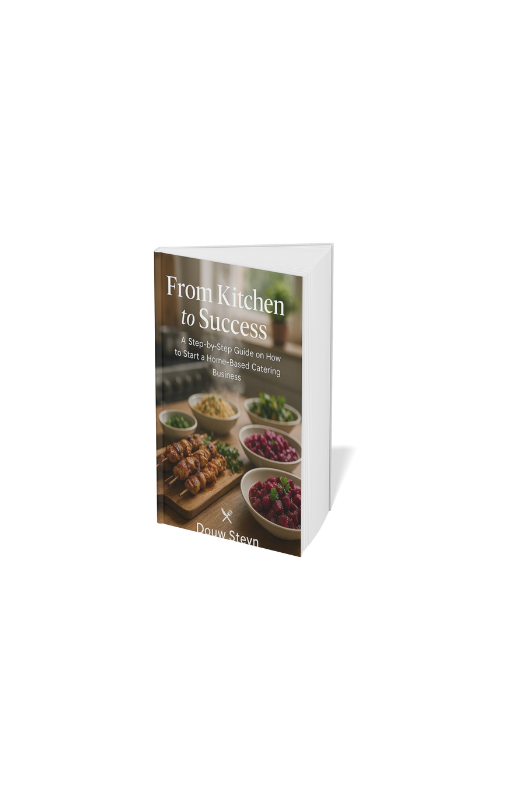
From Kitchen to Success: A Step-by-Step Guide on How to Start a Home-Based Catering Business
The free article gives you a practical overview. The full 101-page eBook takes you further into planning, menu creation, kitchen setup, marketing, operations, customer service and business growth.
Topics covered include:
- Understanding the catering industry
- Planning the business
- Developing a suitable menu
- Setting up the home kitchen
- Marketing and branding
- Managing operations and logistics
- Providing customer service
- Scaling the business responsibly
Frequently Asked Questions
Can I start a catering business from home in South Africa?
It may be possible, but you should first investigate municipal, environmental health, property and food-safety requirements that apply to your location and proposed operation.
Do I need a commercial kitchen?
The answer depends on the food you prepare, your production methods, the scale of the operation and the applicable local requirements. Ask the responsible local authority before investing or trading.
How much money do I need to start?
A small test may require relatively little when you already have suitable equipment and storage. Costs increase when additional appliances, refrigeration, packaging, delivery equipment or premises changes are needed.
Do I need formal chef qualifications?
Formal chef qualifications are not the only measure of readiness. You still need reliable recipes, safe food-handling practices, consistent quality, accurate costing and professional customer service.
How should I price catering food?
Include ingredients, packaging, labour, utilities, transport, wastage and a contribution towards general expenses and profit. Do not price using ingredients alone.
What food is easiest to sell?
There is no universal best product. Begin with food that matches local demand, your cooking strengths, available equipment, transport conditions and the price customers are willing to pay.
How can I find my first customers?
Create one clear offer, take good photographs and approach people within relevant local networks. Use pre-orders, deliver reliably and ask satisfied customers for reviews and referrals.
Can I start the business part-time?
Yes, some caterers begin with weekend functions, weekly meal offers or pre-ordered platters. Ensure that you can meet customer deadlines without compromising your employment, health or family obligations.
How profitable is a home catering business?
Profit depends on selling price, ingredient costs, labour, packaging, waste, transport, overhead expenses and repeat customers. High sales do not necessarily mean high profit.
Should customers pay a deposit?
Deposits can reduce the risk of buying ingredients for an order that is later cancelled. Explain deposit, cancellation, delivery and refund terms clearly before accepting payment.

Douw Steyn
Douw Steyn is a South African entrepreneur, business author and founder of How To Books ZA. He creates practical guides for people exploring small business, self-employment and additional income opportunities.
His approach is based on helping readers start small, investigate the market, understand the costs and build what works without relying on unrealistic income promises.
Why trust this guide? This page is part of the How To Books ZA business guide library. It is designed to help South Africans investigate a business opportunity realistically before committing significant money.
Editorial Policy and Disclaimer
H2BZA guides are written to be practical, beginner-friendly and relevant to South African readers. Content is reviewed and updated when necessary, but requirements, prices and market conditions can change.
This article provides general educational information. It does not constitute legal, tax, municipal, health, food-safety, insurance or financial advice. Confirm requirements with appropriately qualified professionals and the responsible authorities.
No income or business result is guaranteed. Outcomes depend on customer demand, pricing, costs, skills, compliance, competition, execution and other factors.
Related South African Business Guides
Ready to Investigate Your Home Catering Business?
Use the free guide to assess the opportunity, calculate the costs and plan a controlled first test. Get the complete eBook for a more detailed roadmap covering planning, menu development, kitchen setup, marketing, operations, customer service and growth.