Don’t Ask “What Can I Farm?” Ask These 7 Questions Before Starting an Agriculture Business in South Africa
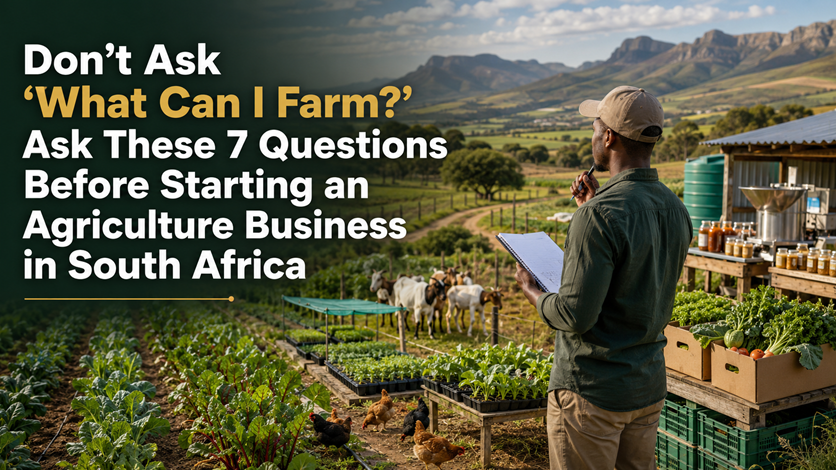
The crop, animal or product is only part of the decision. Before you invest in land, equipment, livestock or stock, work out who will buy, what you can deliver reliably, how long your cash must last and whether farming is even the best place for you in the agricultural value chain.
“What can I farm?” sounds sensible. It can also send you in the wrong direction.
You may have access to a piece of land. You may have seen somebody making money from chickens, vegetables, goats, seedlings or honey. Perhaps a social-media video made an opportunity look simple. The natural response is to ask: What should I farm?
But agriculture is a business before it becomes an income. A technically possible crop can still be commercially weak. A profitable-looking livestock enterprise can struggle if feed costs, mortality, transport or slow-paying customers consume the margin. And sometimes the strongest opportunity is not to produce anything at all: it may be to process, package, distribute, market or provide a service to existing producers.
A better question is: “Which agricultural customer problem can I solve profitably with the resources I can realistically control?”
That question forces you to connect the farm to the customer, the production cycle to cash flow, and the business idea to evidence.
Find demand
Identify the buyer and what that buyer actually needs before scaling production.
Test the numbers
Include the full operating cycle, losses, logistics and the delay before you get paid.
Start controlled
Use a pilot to replace assumptions with evidence before committing larger capital.
Ask These 7 Questions Before You Choose the Farm
You do not need perfect answers before you begin researching. You do need enough evidence to know which questions deserve more money, time and attention.
Who is going to buy from me?
Start with a real customer, not an imaginary market.
“People eat vegetables” is not a market. Neither is “everyone buys chicken”. A business needs a clearer buyer: households in a nearby township, restaurants, a local butcher, informal traders, a fresh-produce market, a supermarket supplier, processors, nurseries, schools, hospitality businesses or another defined group.
Talk to potential customers before you produce at scale. Ask what they buy, how often they buy it, what quality they expect, how it must be packed, what quantities they can absorb, how they want it delivered and when they pay.
This is particularly important when the production cycle is long. Buying cattle, planting an orchard or building large poultry capacity before understanding the buyer can lock your cash into a business model that is difficult to change.
Do I actually need to farm, or could I make money somewhere else in the value chain?
Agriculture is much bigger than primary production.
If you do not own land, have limited water, lack production experience or cannot afford a long growing cycle, that does not automatically exclude you from agriculture. Producers need customers, transport, seedlings, feed, packaging, recordkeeping, marketing, aggregation, processing, maintenance and many other services.
An entrepreneur near a cluster of farms may be better positioned to wash and pack produce, raise seedlings, aggregate orders, transport goods to market or help producers improve presentation and labelling than to compete with those same farmers in production.
The question is not “How do I become a farmer at all costs?” It is “Where in this agricultural system can my resources and skills create the strongest commercial fit?”
What resources can I reliably control?
Build around what is available, affordable and dependable—not what you hope will appear later.
Land matters, but it is only one resource. Water, electricity, storage, fencing, labour, transport, technical skills, working capital, security and access to customers may matter just as much.
A small irrigated plot close to buyers may support a stronger first business than a much larger piece of land far from water and markets. A backyard, tunnel, shade-net structure or leased space may be enough to test seedlings, herbs or another compact enterprise before you take on larger fixed costs.
Separate resources you control from resources you merely expect to obtain. If a business only works after an uncertain grant, loan, land allocation or large infrastructure upgrade, you do not yet have the same proposition as a business that can be tested with resources already available.
How long can I wait before the business pays me?
Profit on paper does not solve a cash-flow problem.
Agricultural businesses often spend money before they make money. Seed, feed, fertiliser, labour, packaging, fuel, veterinary costs and other inputs can occur well before the first sale. Even after a sale, some customers may not pay immediately.
Compare the production cycle with your personal and business cash runway. A faster turnover enterprise can sometimes be a more suitable first step than an opportunity with an attractive theoretical margin but a long wait for revenue.
Build a simple month-by-month cash-flow estimate. Mark when money leaves, when sales are expected and when cash is actually likely to reach the bank account. Include a buffer for delays, lower output and unexpected costs.
What happens if yield, price or demand disappoints me?
Do not budget only for the version of the business in which everything goes right.
Agriculture carries biological, weather, market and operational risk. A production estimate can be wrong. Mortality can be higher than planned. Feed or fuel can become more expensive. A buyer can reject stock. A crop can reach market when many other producers are selling the same thing.
Run at least three simple scenarios: expected, weaker and severe. Ask whether the enterprise can still operate if selling prices fall, volumes decline or costs rise. This does not mean trying to predict every crisis. It means avoiding a plan that survives only under ideal assumptions.
Diversification can help, but adding five weak activities does not automatically create one strong business. Stabilise the first commercial engine before adding complexity.
How will the product reach the customer—and what will that really cost?
The route to market is part of the business model, not an afterthought.
A farm-gate sale, farmers’ market, farm stall, WhatsApp order, restaurant delivery, fresh-produce market and supermarket supply arrangement can produce very different margins from the same product.
Compare not only the selling price but also packaging, transport, time, commission, spoilage, rejection risk, credit terms and minimum volumes. The channel that offers the highest nominal price is not automatically the channel that leaves you with the most money.
Direct selling may give you more control and customer feedback, but it also turns the producer into a marketer, order manager and distributor. Wholesale can move larger volumes, but may impose tighter standards and thinner margins.
Can I test this opportunity on a small scale first?
Your first production cycle should teach you something—not trap you.
A pilot cannot remove agricultural risk, but it can reduce the cost of being wrong. Instead of immediately building the final version of the business, test a controlled version that answers the most important uncertainty.
If the main uncertainty is customer demand, pre-sell or secure buyer conversations. If it is production, run a smaller cycle and measure actual yield, mortality, labour and input use. If it is a farm stall, test selected trading days before investing in a permanent retail structure.
Decide in advance what evidence would make you expand, revise or stop. Otherwise it is easy to keep investing simply because you have already spent money.
Where in Agriculture Could You Build a Business?
Once you have worked through the seven questions, you may discover that the best opportunity is different from the one you first imagined.
Grow crops
Vegetables, herbs, fruit, seedlings or other plant-based enterprises.
ProductionRaise poultry or livestock
Build around feed, animal health, production discipline and confirmed demand.
Plant supplyRun a nursery or seedling business
Serve gardeners, farmers, landscapers and other plant buyers.
Value additionProcess agricultural products
Turn raw agricultural outputs into products with added convenience, shelf life or value.
Support servicePackage and present products
Help agricultural businesses improve presentation, handling and route-to-market readiness.
MarketingHelp farms find customers
Use digital channels, storytelling and direct communication to build market access.
Do Not Choose the Opportunity on Excitement Alone
A promising agriculture business usually has several pieces working together. Weakness in one area does not always kill the idea, but it tells you what must be tested or solved first.
You can describe who buys and why they would choose your offer.
You can produce or deliver reliably with the local resources available.
You can fund the operating cycle and survive delays or weaker months.
The selling price covers realistic costs, losses, logistics and overheads.
You know how the product reaches the buyer and what the channel costs.
You understand what can go wrong and how much exposure you can tolerate.
You have identified the rules, standards, permits or registrations relevant to your specific activity.
You can test important assumptions without committing the full-scale budget.
Compliance is product-specific.
Agricultural requirements can differ according to the product, processing method, claims, market and route to sale. Before investing, verify the requirements that apply to your specific enterprise with the relevant authorities and recognised industry bodies.
Not Sure Which Agriculture Business Fits You Yet?
Use the H2BZA Agriculture Business Guides hub to compare production, agro-processing, agricultural services, inputs, distribution and digital opportunities—and then move into the guide that matches the path you want to investigate.
Practical Guides for Different Agriculture Paths
Once you have narrowed the opportunity, use a more focused guide to test the operating model, customers, costs and route to market.

Starting a Farm in South Africa
A practical starting point for turning a farm idea into a more structured business.
View the Book
Vegetable Farming Business
Connect crop planning to buyers, pricing, costs, production cycles and growth.
View the Book
Poultry Farming Business
Build around real demand, disciplined production, cost control and controlled growth.
View the Book
Sustainable Goat Farming
Explore herd planning, production, customers, value addition and responsible growth.
View the Book
Agro-Processing Business
Evaluate raw materials, processing, equipment, compliance, packaging and markets.
View the Book
Packaging & Labelling Basics
Understand practical packaging, presentation and labelling considerations for agricultural products.
View the BookStarting an Agriculture Business in South Africa
What is the first thing I should do before starting a farming business?
Start by defining the customer and testing demand. Find out what buyers need, what volumes and quality they expect, what they pay, how delivery works and when they pay. This gives the production plan a commercial target.
Do I need to own land to start an agriculture business?
Not necessarily. Depending on the model, possibilities can include leasing land, starting with a small controlled production area, seedlings, processing, packaging, distribution, marketing or services supplied to farmers.
Which farming business is the most profitable in South Africa?
There is no single answer. Profitability depends on the local market, production fit, input costs, losses, capital requirements, selling price, route to market and management. A smaller enterprise with reliable buyers can outperform a larger operation with weak margins.
Should I find buyers before I start producing?
Where practical, yes. Buyer conversations can reveal quality, volume, packaging, delivery and payment requirements before you commit to scale.
Is it better to start small?
A controlled pilot can reduce the cost of being wrong and produce real information about demand, yield, costs, labour, losses and logistics before a larger investment.

Check the Requirements for Your Specific Agriculture Business
Requirements can differ according to the agricultural product, production method, processing activity, claims made on the product, location and intended market. Use official sources and appropriate professional or industry advice when the decision requires it.
- South African Department of Agriculture
- Department of Agriculture: Food Safety & Quality Assurance
- Companies and Intellectual Property Commission (CIPC)
- South African Revenue Service: Small Businesses
Important: This article provides general business information. It is not legal, tax, veterinary, agronomic, environmental or financial advice. Confirm the rules and technical requirements relevant to your specific product, location and business model before investing.